This San Francisco venue had its most profitable year in half a century
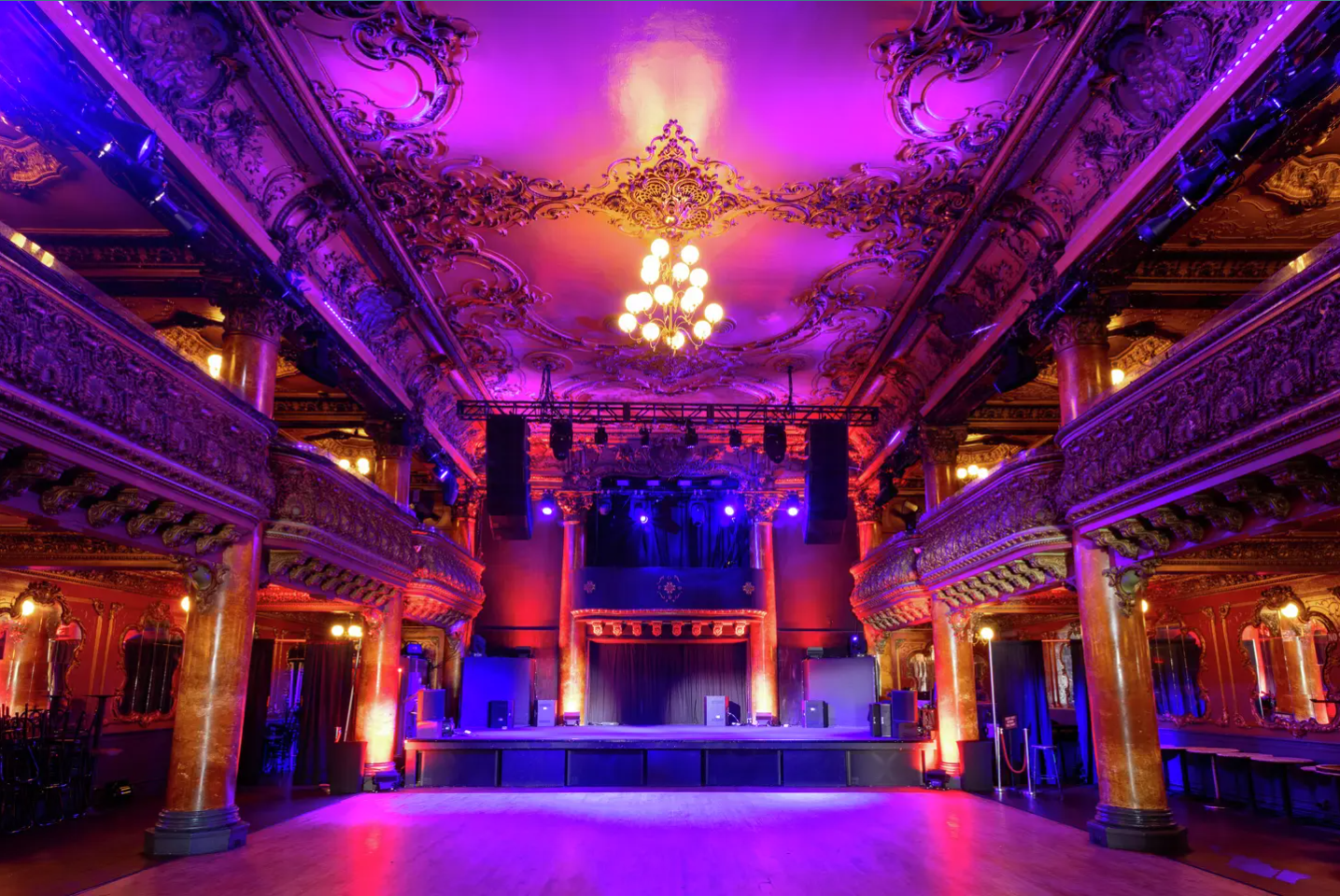
Crossing the threshold on O’Farrell Street and into Great American Music Hall is akin to stepping back in time. It’s a “jewel box,” a time capsule of Edwardian-era design and a reflection of San Francisco’s Barbary Coast days — the embodiment of elegance and notoriety. You may have seen a Mexican cumbia-punk band, burlesque to the tune of David Bowie, or even caught one of Prince’s final performances before he passed.
Much like San Francisco itself, the Great American has lived many lives — at times, it’s been an upscale eatery, a bordello, a cabaret, the site of a handful of gothic-themed weddings, and the home of up to 50 ghosts. Today, it’s one of precious few mid-sized, independently owned venues in a city increasingly populated by corporate music outposts — a fiercely indie space since 1972.
Not much has changed in those 53 years. GAMH was acquired by the owners of Slim’s in 2002 (a group including Grammy-winning blues musician Boz Scaggs, CEO Jonathan Nelson, the late venture capitalist Frank Caufield, and others involved with the Hellman Family Foundation), who have largely left the longtime staff do their thing. The owners see the venue as more of a “caretaker situation,” says general manager and booker Fred Barnes.
“It’s definitely kind of like a family here. People on the whole are very nice and close knit, and we try and treat everyone really well,” Barnes, who started his tenure at GAMH as a security guard in 2009, continues. “We all feel invested in it. This venue is entirely about trying to put on great art for San Francisco. It costs a fortune to do that, but if we do ever make any money, we put it all back into the venue. It’s like a project, almost.”
The attitude — and effort — has quite literally paid off. 2025 has been the Great American’s most profitable year in decades. No one thing has contributed to this success, though Barnes cites recent upgrades to the venue’s sound and lighting systems as a draw, plus “strategic booking” and relationships with indie festivals such as Noise Pop, Psyched! Fest, SF Sketchfest and Substance have been crucial to the Great American’s boom year. “Building a reputation with new audiences in the Bay that have changed since the pandemic and strong yearly partnerships…have all contributed to a calendar that has had more shows and events than ever before, and more sold-out shows than ever before in our history,” Barnes adds.
Back to the Barbary Coast
Turn back the clock a century or so — back before metal shows, legendary blues artists, no-wave nights and bar mitzvahs populated GAMH’s calendar — 859 O’Farrell was Blanco’s. Opened in 1907 by political operator Chris “Blind Boss” Buckley, Blanco’s was a premier destination for dancing, drinking, gambling and carousing.
The club reflected the times with its dazzling, Rococo-inspired stucco balconies, marbled columns, gilded mirrors and two Romanesque ceiling frescos. Yet Buckley had completely lost his sight during the building’s construction and had to describe his vision to a French architect who saw the dream to fruition.
Buckley was also the proprietor of the hotel stage right of Blanco’s, which provided additional services to desirous clientele. “It was a cafe for gentleman, which pretty much means the same thing as a gentleman’s club does now,” longtime sound engineer Lee Brenkman told SF Weekly in 2017. “If young gentlemen of means came in without a date, one could be provided and added to the check.”
While GAMH’s bordello history was widely known, it wasn’t until 1989 that a deeper connection was found. The Loma Prieta earthquake shook so violently that it popped open a secret (and long papered-over) door between the venue and the hotel, located on the second floor balcony.
Barnes adds that, during Prohibition, performances were held around a small stage in Blanco’s basement — which had an entrance to pull a carriage (or Model T) into. Today, the basement has been divided into offices and green rooms, though the stage remains.
San Francisco’s Music Box, a pioneering institution
Blanco’s ran until the early 1930s, then took on new life under the helm of Sally Rand. An infamous fan dancer who rose to prominence for her scandalous performances at Chicago Century of Progress World’s Fair, Rand arrived in the City by the Bay in the early 1930s — likely flush with cash, as her Chicago shows reportedly netted $6,000 per week — and rebirthed Blanco’s as the Music Box.
“She also was a real pioneer, because she was the female business owner of the place. She owned it, ran it, and it was her show. She paid everyone. And so that was quite amazing for the time,” Barnes adds.
Rand’s cabaret performances took place above GAMH’s current stage in what’s now referred to as the “queen’s box.” An orchestra would perform on the stage below, and the star of the show could descend from one of two narrow staircases to wow the audience at a closer proximity. At that time, the floor was recessed about 10 inches for dancing, with seating along the perimeter and upstairs.
“There was a famous incident here where she was arrested and charged because her show was lewd and indecent,” Barnes recalls, adding with a chuckle that there are photos of “all these cops and political people [watching] the performance” trying to determine how indecent it actually was. “As far as I’m aware, she won that [case] and continued to run the place.”
Rand operated the Music Box for several more years, including through her performance at San Francisco’s own World’s Fair in 1939. There, her “flesh show” the Sally Rand Nude Ranch was among Treasure Island’s most popular attractions.
A most exclusive menu
The 5,000-square-foot venue went through multiple hands post-Music Box era. It closed near the end of WWII and was home to the Loyal Order of Moose in the 1950s, and was briefly the Cotton Club, known for its interracial band. The following decade, French restaurateur Charles Robert, who owned another restaurant near the Embarcadero, opened an exclusive, eponymously named eatery. Per SF Weekly, Charles had an unlisted phone number, and reservations could only be made if you personally knew the owner or head bartender. Lamb was the only red meat on the menu, but the kitchen had “a stove top big enough to make 50 gallons of soup stock at a time.”
Robert’s restaurant lasted just 18 months. He was eventually investigated for tax evasion and vanished from the city. 859 O’Farrell was then sold at an IRS auction. All that remains of Charles the restaurant is a barely noticeable C painted onto a plaster coat of arms at the corner of the ballroom.
53 years of the Great American
The Great American Music Hall was officially christened in 1972. Initially a jazz club that played host to Sarah Vaughan and Duke Ellington — who had a purpose-built dressing room and shower in the basement for his ’70s residencies — as well as many other jazz greats, such as Bill Evans. Thus began a tradition of live albums recorded at GAMH, including singer Carmen McRae’s 1976 “At the Great American Music Hall” and Sonny Rollins’ “Don’t Stop the Carnival” from 1978.
GAMH’s calendar expanded to include blues artists like B.B. King, soul legends such as Etta James and a litany of rock acts. After auditioning more than two dozen drummers, Journey debuted with drummer Aynsley Dunbar (who played on the group’s first four albums) at GAMH in February 1974. Jerry Garcia and the Grateful Dead performed at the Great American often, and recorded “One From The Vault” at the venue in 1975. Many stories about the band and their fans’ antics remain:
“[The Dead] wanted to start [a] performance with the sound of crickets. Instead of using a tape, they got a ton of live crickets down here and mic’d them up,” Barnes said from GAMH’s basement. “But it was too dark, and not the right temperature, so [the crickets] didn’t respond. So then they just had all these crickets escaping everywhere, and they ended up having to use the tape. For a long time afterwards, there were crickets all over the place.”
Van Morrison played GAMH dozens of times in the ’70s and ’80s, during a period when he lived in Northern California. Some of Robin Williams’ earliest performances were on the Great American stage; clips of his 1982 TV special “An Evening With Robin Williams” are available on YouTube. Ani DiFranco, Jeff Buckley, Wilco and Maceo Parker also made appearances at the venue up through the 1990s.
In 2000, GAMH was sold to a startup called Riffage.com, which planned to operate the venue and website (where it would stream live shows), and also acquired LA’s 1500 Records. While Riffage planned to use both as “venues for unsigned bands,” the company quickly folded. Enter the Slim’s crew.
In the two decades and change since current ownership took over Great American Music Hall, the 700-capacity venue has seen the likes of English singer-songwriter icon Elvis Costello, “pope of trash” John Waters, indie star Phoebe Bridgers, Aussie rockers Amyl and the Sniffers, ska stalwarts the Slackers, and Papi Saico of pioneering Peruvian punks Los Saicos.
“We try and keep it as broad as possible. Artistic brilliance definitely leads what we do. We definitely go into big ventures, residencies and stuff, knowing that we’re going to lose money, and we do it anyway,” Barnes says of GAMH’s booking philosophy.
In an era of increasing corporate competition, where indie venues are often outbid by organizations with more buying power, Barnes says artists keep coming back to the Great American. “We have the best room. Some artists specifically want to be here and nowhere else.”
Audiences love GAMH, too. Great American staff receive “a lot of happy emails, comments from people, weddings by people who met their partners here,” Barnes adds. “That is really what we do it for, our loyal audience [to] feel at home.”
Uncovering the music hall’s mysteries
Running an independent venue — in this economy, with young people who drink less and are reshaping nightlife — is no small feat; doing it in a 118-year-old building adds an additional layer of complication. “It’s a little bit like the Golden Gate Bridge or something; you’ve just got to keep constantly painting it, doing bits up,” Barnes notes.
Yet he and the crew at GAMH are actually quite lucky. Great American Music Hall is solidly built — perhaps due in part to the half dozen redwood columns encased in a marble effect — and doesn’t leak in rain. Experts have to be brought in occasionally to repair cracked molding, but otherwise, maintenance is handled in-house.
The sounds coming out of GAMH may have changed over the century, but the space is pretty much as it was in 1907, with a few minor changes. At some point, the hall’s yellow walls were painted red and the stage was redesigned with musicians in mind. The two ceiling frescos were cleaned to remove years of smoke and, in the 1970s, artists touching up the mezzanine walls added a discrete marijuana leaf to an original painting. An adult-sized safe from the Blanco’s days is now a storage room.
Other parts — or people — from Great American’s long history also linger. Private event manager Evita Salazar and Barnes reported seeing an apparition in a blue cape, and hesitantly ascribe to the rumor that Duke Ellington haunts the place. Sally Rand, the former Music Box owner, has also been spotted long after leaving the earthly realm.
“There are a lot of people here who have seen things. I’m not that into that stuff, but I have just seen one thing,” Barnes says, recalling a time when he and a former manager were locking up after a particularly crazy show. Barnes spotted what he thought was a languishing drunk patron in a blue cape walking at the end of the hall, and hollered at him to leave.
The person didn’t respond, and instead walked into a bathroom. “I thought, ‘I’m not going to confront them in the bathroom. I’ll just wait for them to come back out again,’” Barnes says. After five minutes passed, Barnes began to worry that the person had passed out in the stall and barged in — only to find the bathroom completely empty. “I’d been watching the whole thing; I knew they hadn’t come out. There’s no other way out there.”