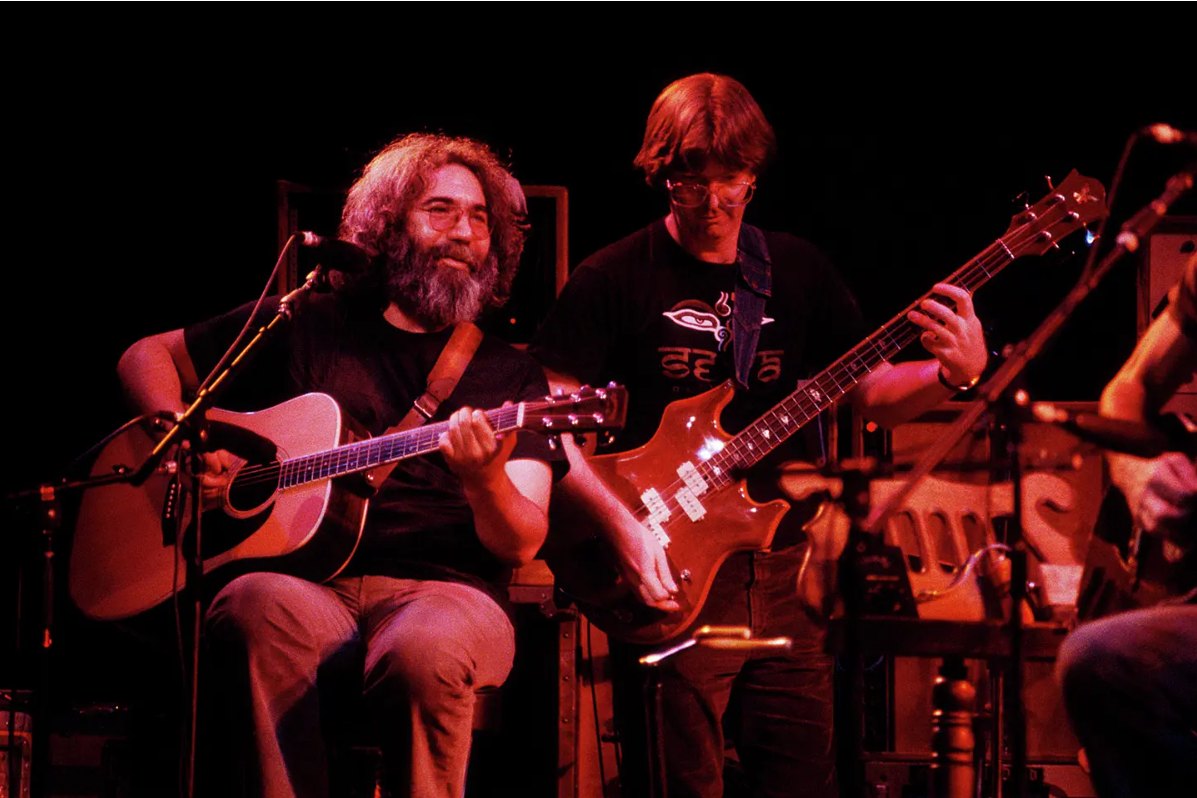
The San Francisco venue where the Dead were kings and Bob Dylan was booed
San Francisco’s Mid-Market District is a microcosm of the city’s history, a main artery for commerce and transit that has seen great highs and deep lows, from the bustling 1920s, which saw expanded development of Market into “one of the great streets in the world,” to divestment and demolishing in the 1960s, and tech-led gentrification in the 2010s and beyond. Among the buildings that have seen it all — and ridden the changing tides — is the Warfield.
While now operated by Goldenvoice/AEG and host to rock, metal and alternative acts, the Warfield’s 104-year-old history touches nearly every genre of music. If it was popular in San Francisco, it probably graced the Warfield’s stage at least once (or, in the case of the Grateful Dead, 15 times in 19 days).
While the Warfield doesn’t host many local or upstart bands, it remains an important place for touring rock and rock-adjacent groups (not to mention the litany of rap and electronic acts on the venue’s calendar). It’s also one of few venues of its size in the city, with a max capacity of 2,454 — a sweet spot for some acts and bookers. Its closest competitor is the Fox Theater in Oakland, which can hold up to 2,800 people and is operated by Another Planet Entertainment.
There’s more for your money in a Warfield show
As with most major cities, San Francisco has long loved stage and screen. For decades, the city’s movie theater district was concentrated along Market Street between Mason and Polk streets, anchored by studio-run chains like the Fox, Paramount, Embassy and Strand. The district included several live‐production theaters that, together, attracted people from throughout the Bay Area.
“Theater venues like the Warfield were tied to thriving, diverse cities like San Francisco, where, importantly, residents had access to cheap public transportation,” said Felicia Angeja Viator, an associate professor of history at San Francisco State University. “They were spaces for free expression, cheap enough for working-class folks and as popular as amusement parks.”
The Warfield opened on May 13, 1922, as Loew’s Warfield — a “grand dame of a theatre” dedicated to film and vaudeville with a capacity of over 2,650 and a 33-foot-deep stage. The venue was the 300th theater commissioned by Marcus Loew and the 26th opened by his company within 18 months. The Warfield was built by local architect Gustave Albert Lansburgh; the early ’20s were a boom time for Lansburgh, who simultaneously designed the neighboring Golden Gate Theatre (which also opened in 1922).
Loew’s new theater featured a marbled lobby with gilding and chandeliers, a grand staircase and, in the theater itself, a “lyrical mural … of floating matadors and their senoritas, as well as the dismembered head of their animal victim,” per the Warfield’s website. Loew seemed to spare little expense, hiring lauded muralist Albert Herter to paint the theater’s proscenium arch.
The San Francisco Chronicle lavished praise upon the new theater in its issue on May 7, 1922, spilling much ink about the design. “One is struck on entering the Warfield by its width and the symphony of tones in which it is decorated,” writer George C. Warren opined. “… The mural decoration carries out the general design of the house — that of a fan. From the painting spreading panels extend to the walls, narrow where they join the mural; and widening as their rays reach out, each ending in a sunken circle which will be lighted and in each of which there is a sunburst in metallic colors.”
A theater of such grandeur demanded a weighty name. Though it was originally set to be called Loew’s State, Loew decided to name the space for his friend David Warfield, an SF native who began his career as an usher and who grew to become a renowned stage actor — one of the few millionaire actors in the pre-film age — though it’s unlikely Warfield performed at his namesake venue, having moved to New York in 1890.
The day before opening, the Chronicle ran nine pages about the new venue. Opening day saw a host of celebrities in attendance, including Viola Dana, star of “The Fourteenth Lover,” which screened for a week. If such fanfare was typical for the era, Loew knew how to keep audiences coming back for more: A five-story high billboard on the side of the building proclaimed: “There’s More for Your Money in a Warfield Show.”

Rocking at the Warfield
Per the Warfield’s website, “All of the big names in entertainment played on The Warfield’s stage.” Beyond film, the venue hosted Al Jolson, Louis Armstrong, Charlie Chaplin and even “dog” shows with “the likes of Rin Tin Tin,” the website says. Vaudeville acts — which often required large casts — were accommodated with 20 dressing rooms in the backstage area.
“In the early 20th century, vaudeville performances functioned like variety shows, where you’d be treated to a bit of stand-up comedy, a short skit, maybe a drag show along with a short, projected film and a live music performance,” Viator noted.
Viator described vaudeville shows as the Warfield’s “bridge between its early start as a movie house and its later reputation as a live music venue.” Much like the Castro Theatre, which opened in June 1922, the Warfield eventually turned its focus to movies.
Today, the Warfield building is subdivided into 22 condominium units (the 23rd unit is the theater itself), which have hosted a variety of businesses and characters in its century-plus run. 7x7 reported that Al Capone rented a penthouse office space within the building before his Alcatraz imprisonment.
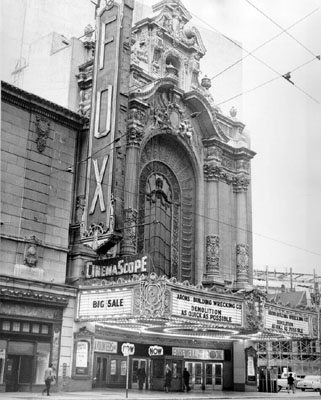
The Fox West Coast Theatres chain — which had a namesake theater at 1350 Market St. — leased executive office space in the Warfield building in the mid ’30s. After the Fox Theatre was demolished in 1963, the Fox chain took over operations and renamed the space the Fox Warfield; it operated as a movie theater, under various management companies, into the ’80s. During that period, the venue was occasionally used as a nightclub called Downtown.
The times were a-changin’ for the Warfield by the late ’70s, however. The venue came under the management of Bill Graham Presents in 1979, which brought in Bob Dylan for a slate of 14 shows in November for his gospel tour era. (Dylan would play another run of 12 shows in November 1980.) Crowds and concertgoers weren’t pleased — mostly due to Dylan’s born-again material.
“By all accounts, the opening-night response was the worst. Isolated boos and catcalls (‘We want Dylan!’ ‘Rock & roll!’) punctuated the twenty-five-minute opening set by Dylan’s black backup gospel singers,” Rolling Stone reported at the time. “... After ninety minutes, Dylan, who didn’t talk to the audience throughout most of the set, said, ‘That’s the show for tonight. I hope you’ve been uplifted.’ At that point there was more booing, and several members of the crowd walked out in apparent disgust.”
Bad press didn’t deter Dylan, his fans, Graham or generations of rockers to come. Many legends performed on the Warfield stage in the ensuing years, from Prince, James Brown and David Bowie to the Clash, Green Day, Slayer and Rancid. Multiple scenes from 1991’s “The Doors” were filmed at the venue.
The final Bill Graham Presents performance was held in 2008 with Phil Lesh; the venue’s management lease was subsequently taken over by AEG’s Goldenvoice Presents. The Warfield closed briefly for a renovation — the Chronicle noted in September 2008 that the mixing console was moved to make space for 30 more prime reserved seats, the lobby walls were painted to match new carpets and the chandeliers were polished — before reopening with comedian George Lopez.
Behind the lens with Jay Blakesberg
During the Bill Graham Presents years, the Grateful Dead became something of the Warfield’s house band. They performed at the venue 21 times between 1980 and 1983, including 15 gigs in 1980 alone. That particular run — an acoustic and electric performance — was the longest in the band’s history and was memorialized on multiple live albums, including “Reckoning,” “Dead Set” and “The Warfield.”
The Dead were then playing arena gigs; to see them in a 2,200-capacity theater (at the time, the venue still had seating in its orchestra section) was a special treat for fans. “There were a lot of people hanging out on the streets, busking, playing music,” said photographer Jay Blakesberg, who flew in from New Jersey to catch six of their 15 shows.
BGP didn’t even put the band’s name on the marquee, letting a Steal Your Face skull and a banner with the words, “They’re not the best at what they do. They’re the only ones that do what they do,” be a beacon. The lobby was turned into a Dead museum, with photographs, posters and artifacts in glass cases. Those November 1980 shows were the first time that Dan Healy, the Dead’s audio engineer, put speakers in a venue lobby. “It was like a big psychedelic, swirling scene going on in the lobby with people dancing with all the doors closed,” Blakesberg said.
An inside marquee featured quotes and lyrics from the band, “So as you were walking out, you sort of got this Grateful Dead lyric to send you home,” Blakesberg remembered. “They really decked it out for the fans and really made it a fan experience.”
The photographer also recounted that the venue lobby was wallpapered when BGP took over. He noted that BGP stage manager Bob Barsotti “found a bunch of Deadheads and said, ‘If you guys come in and peel the wallpaper off of the marble, I’ll give you free tickets to some shows.’ So he bartered labor with Deadheads to restore the lobby to its glory of yesteryear.”
The Warfield run holds great importance in the Dead’s lore. “1980 was just before things started to blow up. It was still sort of a pure period of Grateful Dead history,” Blakesberg recounted, adding that the same period saw lineup changes. “It sort of reinvigorated this band ... they started rehearsing again. And by the summer of 1980, the Grateful Dead were a band that was on fire. By the time they got to the Warfield, they were really, really firing on all cylinders.”
It was also the beginning of Blakesberg’s own relationship with the venue. He officially moved west in the mid-1980s and became a volunteer usher at the Warfield — “It was a great way for me to get to see free music,” he said — and brought his camera along. Blakesberg shot Yoko Ono, Elvis Costello and Prince’s 1986 show. “My girlfriend at the time was an usher, and she stuck my camera in. I took a couple pictures of Prince before his security caught me and found me and threw me out.”
Blakesberg soon got his credentials and shot his first assignment for Rolling Stone in November of 1987. By the end of the decade, “I was a regular at the Warfield, and I shot everybody from David Bowie to Lenny Kravitz to Nirvana, numerous Phil Lesh and Friend shows, and the Jerry Garcia band.” He’s since photographed hundreds of concerts.
History rings on
The Warfield looks strikingly similar to the way it was over a century ago, save for some paint and new seating design. There are empty wooden telephone closets and, as SF Weekly reported, visible “tracings of the ironwork that lifted elephants from below the stage.”
“[The Warfield has] has this old, opulent interior that dates back a century. You don’t get it from the outside but inside, you can still squint and imagine you’re in the past,” said Crispin Kott, the co-author of the “Rock And Roll Explorer Guide to San Francisco and the Bay Area.” He continued, “I think that kind of lends itself to a bit more reverence when it comes to shows. People feel like it’s an experience and it’s different.”
Some of the Warfield’s most interesting relics are underground, surviving when the construction of BART shrank the venue basement. Still, per SF Weekly, “neon paintings from the era when Bill Graham himself ran the venue can still be found on the walls. There are also bullet holes in one wall that date from a party in the ’80s when a guard let attendees fire his gun for fun.”
Also below the theater floor is an infamous autograph room, a wall-to-wall (and floor-to-ceiling) who’s-who of performers. In a photo posted to Instagram, scribblings from David Byrne, Johnny Ramone and Bill Clinton are visible. SF Weekly found signatures and marks from former President Barack Obama, Nirvana and Anna Nicole Smith.
The Warfield was also home to “a lot of really important Bill Graham people” who went on to have influential careers in the Bay Area concert business. Blakesberg cited Sherry Wasserman and Gregg Perloff (who now run Another Planet Entertainment), promoter Danny Scher, booker Michael Bailey, and stage manager brothers Pete and Bob Barsotti.
The future of 982 Market St.
Just as the neighborhood has evolved, so has the future of the Warfield. The building was purchased for $12 million in 2005 by local broker and real estate investor David P. Addington, whose company declared bankruptcy in 2012. Addington then sold the venue portion of the property to Sonoma-based A&C Ventures for about $6.5 million in 2013. That company extended Goldenvoice Presents’ booking contract, which it’s had ever since.
The larger Warfield building — of which the venue sits at the easternmost corner — has had its own share of ups and downs. At times home to tech companies such as Match.com and Spotify, and at others the site of planned residential development, the Warfield building has been impacted by public safety and quality of life issues common to the neighborhood — long before the pandemic led to an exodus of workers.
Yet the building remains steeped in its media roots. In August 2025, an arts and culture hub dubbed Warfield Commons opened its doors. The Commons’ anchor tenant is public radio station KALW, which has equity in the building now owned by the Community Arts Stabilization Trust. The trust aims to bring “the Warfield back to life as a place for collaboration, production, and creative operations,” SFist reported.
The Warfield and Goldenvoice staff did not return requests for comment, but the venue’s website declares that “the soul of the building ripens with each passing year.” Blakesberg doesn’t go to the Warfield as often as he used to, but he believes in the venue’s legacy — especially among his fellow Deadheads.
“People outside the rock ’n’ roll world look at rock ’n’ roll venues as this frivolous thing,” Blakesberg mused. “But rock ’n’ roll was serious business, because rock ’n’ roll meant something different in 1980 than it does today. The Warfield was really important to San Francisco.”