Inside Paola Puente’s Portable Turntable Museum
Paola Puente, a.k.a. Double Peas, has long been a name in the West Coast’s DJ scene. The Las Vegas-based, L.A.-bred collector boasts a deep collection that reflects her passions and personal history: decades of funk, hip-hop records, a broad spectrum of Latin music, jazz, and soul.
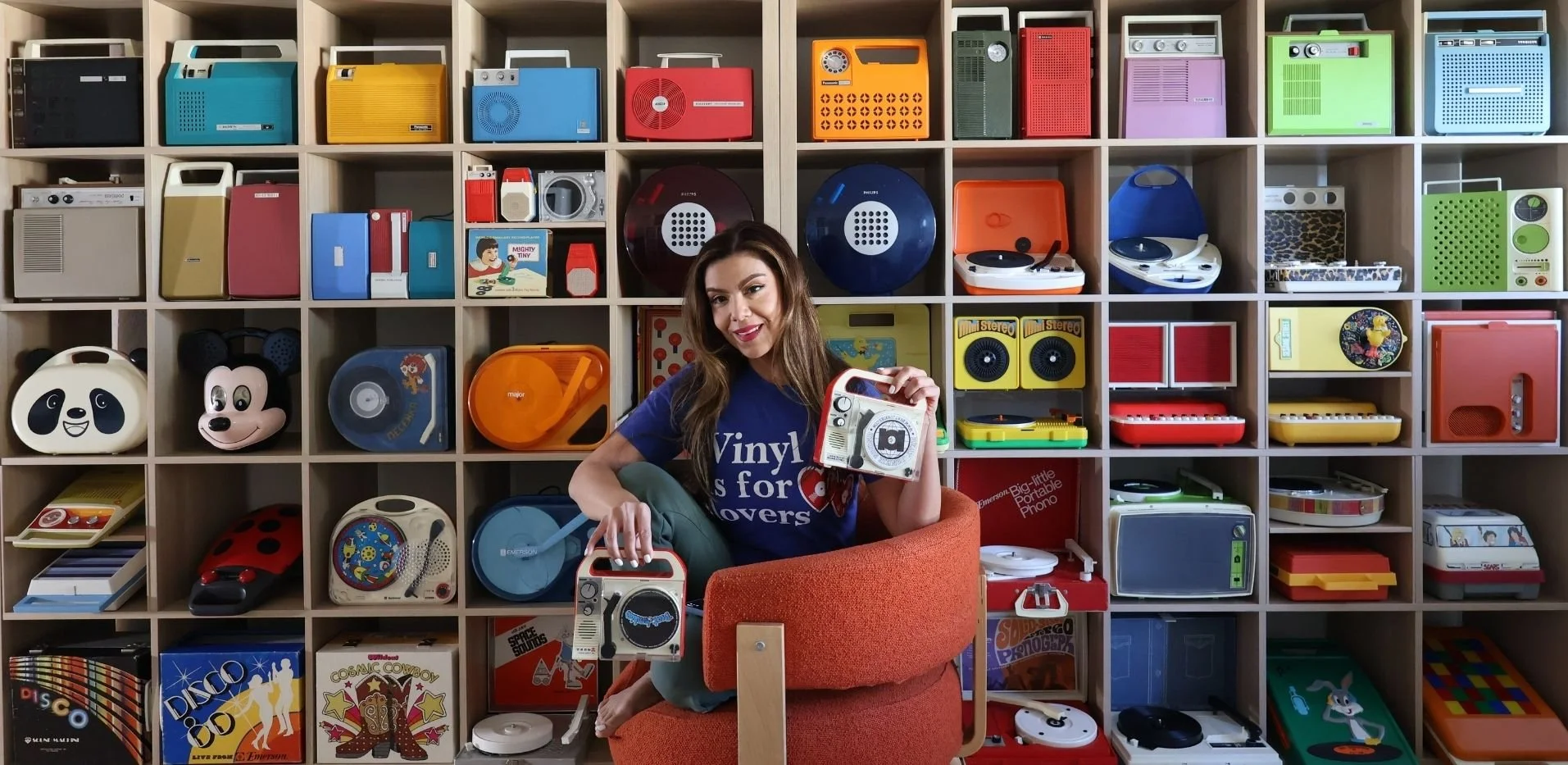
In fact, she’s a collector of many things. Her home and storage units are filled with vintage toys, music-related T-shirts, and multiple platforms to listen to her music. Among those platforms is a massive collection of portable record players made in Japan and the U.S.; “kiddie” players from Fisher-Price and those designed for teens in the 1970s; more traditional-looking setups, and others in the shape of cartoon characters or animals. She estimates that she has about 150 portables.
Puente first began collecting portables 15 years ago. The portables collection is something of a side effect of her record collecting. “Where the records are, you’ll find the portables,” she says. “They definitely influence each other. They go hand-in-hand. Why I get one is because of the other.”
Discogs: Can you tell me a bit about the music and record collecting culture in Las Vegas?
Puente: Vegas is a retiree town; a lot of artists come out here to retire and bring their stuff. And so you actually can find some pretty cool collections out here and meet some pretty cool artists. We have a couple of record stores: There’s one called Wax Trax that’s been here for over 25 years now, and has an amazing inventory. We have a lot of antique stores and thrift shops.
The best thing for me, being out here and collecting, is you can travel anywhere because [Las Vegas is] such a travel hub. So that made it easy for me to stay here, because I was always just jet-setting and being like, “What new place am I going to check out or drive to or fly to look for records?” I actually travel for most of my records.
You’ve been collecting records for a long time; when did the portable collecting start?
I do a lot of the antique malls and thrift stores and garage sales and people’s homes; [portables and records are] all from the same era. Usually, where somebody has a lot of records, you’ll find turntables or portables. That’s pretty much how that started; I’d be looking for records, clothes, and it’s like, “Oh, look, there’s a portable, how cute is that?” I would just start bringing them home. Sometimes they worked and sometimes they didn’t, but I was drawn to the aesthetic of them.
I realized some of them can be pretty heavy duty, and then it got to the point where I wanted to use them. Some of them weren’t working, and I was like, “I wonder how I could fix some of these?” I started researching — these are like the early days of online, so there weren’t a lot of resources — but you could find a couple of websites, and a couple of people that were into fixing them. I’d watch a YouTube video and learn that all you had to replace was the belt drive, and they still sell belt drives somewhere in the country. Needles were another thing you could still find at that time. That just turned into me wanting to rescue them, to bring them home, and fix them up.
So you’re really a self-taught portable turntable mechanic.
Yeah, the school of YouTube. That’s what I call it.
When did you really start collecting these in earnest?
I’d say around 2010. I had my daughter, and I started bringing home more kiddie [players] because I thought I could decorate her room with them. Also, I was home for that year. It gave me more time to go out and look for things like records.
I started transitioning into buying them online on Craigslist and on eBay. But I was mostly finding them out and about. It’s not something that most people think to list online because they’re heavy, and so that comes with a pretty large shipping tag. Garage sales [are] where you can find them for cheap. It was mostly junk at that point.
Can you tell me a little bit about the history of these portables and why they’re actually better quality than somebody might think?
Just like records, there are eras to the portables. There’s ’60s ones or ’70s ones, there are ’80s ones. In the ’90s, you get into the Columbia GP3s and [Vacuum] VP-96, and more of the ones that diggers take out.
You can actually see the evolution of the quality of them. [Portables] got cheaper and cheaper, kind of like everything else, right? The ones from the ’60s are better, longer lasting, than the ones I bought from the early ’90s or anything they’re putting out these days.
There were brands in the ’60s, RCA is a good example, that used quality components. You can tell when you pick it up — it’s heavy. They would use quality needles; the ones that are out now are plastic, and the vintage ones were diamond cut. The manufacturers just used better products: better amplifiers, better wiring, even the belt drives.
It was [also relative to] who they were marketing it to. In the ’60s, it wasn’t really for children; it was just for use. The plastic models and the kiddie models weren’t going to outlast anything made prior to that. For the teenagers, [portables were] on-the-go sound; they were going to go to their party, and bring their tote box of 45 RPM singles with their portable. That’s also when they introduced portables that were battery-operated instead of plug-in.
What appeals to you about portables? Is it aesthetic or the history? The shape? The tech? The sounds?
It’s all those things. I love collecting portables where I can actually find the box that it came in, because then you can not only see the information, the upkeep on it, but the aesthetic of the box. It’s those colors from that era, those avocado greens and those bright oranges, and those fonts I love. It’s the same when you’re looking at album covers.
The actual portable is so beautiful; the colors, the design, the shapes. And then when you listen to them, especially those quality ones, they sound so good. Some came with built-in speakers. Some came where you can attach them to two speakers so you can make it a stereo sound. As somebody who uses them to look for music, I like the portability of taking them out and being able to use them and buy records that way. There are so many records that I would have left behind had I not had a portable with me to actually listen to them.
Do you bring a particular portable with you when you’re digging or do you switch it up?
There are a couple of different ones that I like for that purpose. They have to be small enough for me to travel with. They have to sound good. They have to be able to take the brunt of traveling with me, either in my suitcase or in my car.
I like the Vacuum VP-96; it’s small, it’s punchy, it’s really powerful. I like the Numark PTO1. That’s actually a later one. It feels like a military-grade one to me, like I literally throw it in the back of my car.
I probably have 150. I have maybe a little more than half of those at home. Then 40 of them are in storage. I do have the same portable in different colors; Lloyd’s came out with these groovy prints, and so I have to have the leopard and the vibey ’70s swirl. I can have the same player with a different model number because two different companies made it.
How many portables do you think you have at the moment?
After you’ve been collecting things for so long, you kind of have to be more discerning; otherwise, you’re going to just end up with a lot. I started letting go of the educational, military-grade ones, because they just take up the most space. [But otherwise] I don’t discriminate. I do have them in all sizes. I’ve done like, kind of different storage methods on them. I’ve moved with them four or five times.
They just make really cool gifts. I started having a lot of people reach out to me, like “I want to get my kid into records, but I don’t want to let them play with my Technics 1200s. Is there something you can recommend?” I started gifting or selling some to people, especially for the purpose of just having it in their kid’s room.
A lot of people are gifting [vintage portables] to their parents or their grandparents because they held on to their collection, but not to their players.
Do you have any favorite ones or ones that are most prized, most expensive, most rare, that you want to highlight?
One that I don’t have that’s at the top of my holy grail list — it might be at the top of everybody’s holy grail list — is a banana record player. I’ve had my chance to buy it, but, unlike records, I wouldn’t spend way too much on them. I like the thrill of the hunt and finding them for cheap. If I ever found one of those out in the wild, if it were reasonable, I would definitely pick it up.
Another favorite that I own is shaped like Pink Panther’s head. I love my panda player, simply because you can pull his ear off and it’s a microphone.
I showcase [my portables] like a museum. So I call it the Official Portable Museum, just because it’s my house. When somebody does come over, they’re showcased in a way that I can show them off, but also explain.
Do you find that Japanese portables like the panda player are the best quality players?
Absolutely. We know that Japan knows how to do audio; they definitely surpass the market in portables. Italian models are really good. American vintage ones are actually pretty decent. I probably have more Japanese players than any other country, so that says something.
I know there must be a community of portable collectors. Can you speak to that?
It’s actually very small. I’ve probably met, in person, four people and keep in contact with six or seven. I know there’s a lot more out there, but I don’t know them. One of my closest resources is my friend who lives in San Diego, and he’s got as many players as I do. For a while he was my only go-to for players, to trade and talk about stuff and put each other onto new players.
It’s still a pretty small, niche community, although everybody’s interested in it. Everybody who likes records seems to know about them. They seem to always have, like, one or two lingering at home — especially people who take them out for the sole purpose of digging for records.
What else do you collect?
I really like anything to do with sound or music. You want to feel enveloped in what the kids were listening to, what were they wearing, how they were talking. When I find these pieces, I’m like, “What kind of cool person was into this?”
The same places I find the records, the portables, the clothing, the furniture, I find cassette players — they were mostly made by the same brands that were making the portables. I love transistor radios…they also came in really cool designs. One of my favorite transistor radios is shaped like Fat Albert. Another thing I collect is Walkmans; there’s one that is a Mr. T Walkman and the little headphones have his feather earring. There’s eight track players, because I still play eight tracks, and I still play cassettes.
So all of these are not just because of how they look, but for the functionality of the media to be played on them. It’s really hard for me to leave these things behind because they’re so adorable, or they’re aesthetically cool, or they sound good.
I love vintage toys. These are actually just pieces that I’m recollecting that I grew up with. I love the boxes, I love the information, the artwork, the fonts. This all stemmed from collecting records.
I’m focusing more of my time on the little 45 boxes. They’re also a big bulk of my collection, and that is simply because people personalize those so it fits their aesthetic. They’re obviously DJ friendly, but I started meeting a lot of people that now have designed their own, or they’ll pinstripe their own, paint their own. I just think that’s super cool.
Tell me about your regular gigs, or any events you’d like to highlight.
I do my own monthly out here in Vegas with my crew called The Sundown Soul Club, and that’s something we do every month. It’s in Downtown Vegas, every third Friday.