‘The darker times get, the more important it feels’: The enduring joy of NPR’s ‘Wait Wait…Don’t Tell Me!’
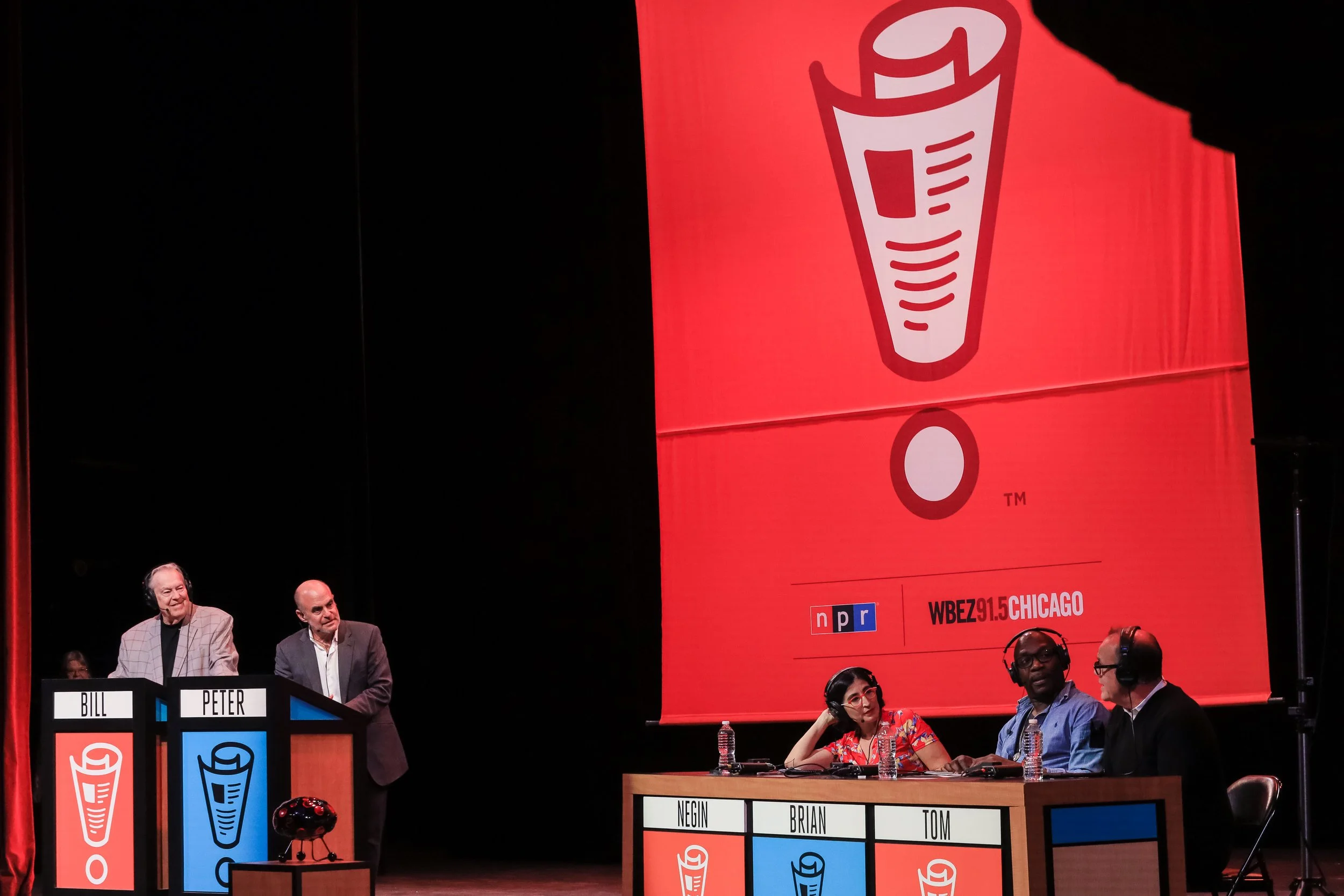
Queues curled around the campus theater and parking spilled into auxiliary lots as approximately 4,000 people converged on Sonoma State University to hear inane stories from the week’s news. This wasn’t Sonoma State’s comedy troupe (no shade to the Improvaholics), but a taping of NPR’s “Wait Wait…Don’t Tell Me!”
While normally held before a live audience at the Studebaker Theater in Chicago, the long-running weekly news quiz occasionally takes its show on the road. The sold-out crowd at the Sonoma event roared with laughter as they listened to tales about UCLA scientists using OnlyFans to fund marmot research, a Turkish governor who was removed from office for wearing bicycle shorts and the new trend of “strategic wrinkles.” Local author Mary Roach detailed the time she flew to the Republic of Georgia to research a finger penis for her book “Replaceable You.”
“Wait Wait” is part journalism, part comedy show, part civic gathering and, by conventional media logic, shouldn’t work as well as it does. Yet the hourlong program, which debuted on Jan. 3, 1998, is one of NPR’s most enduring programs and perhaps its funniest. In spring 2026, the program reached roughly 3.2 million listeners each week, according to NPR statistics, with an average of 1.98 million listeners during any 15-minute period that the show was on air.
It is the 35th most popular podcast in the U.S., according to Edison Research, with over 909,000 weekly downloads. “Wait Wait” has previously cracked Spotify’s top 100 podcasts.
If “Wait Wait…Don’t Tell Me!” sounds chaotic, that’s because it is — at least a bit. Each week, host Peter Sagal and newly appointed announcer Alzo Slade are joined by a chorus of comedian panelists and celebrity guests to talk about the week’s news. Contestant callers from around the country (among those at the Sonoma show was a former special ed teacher who aims to make her loved ones chubby with baked goods and inexplicably fights crime at night) listen for the rhyme in a Mad Libs-style exercise and play the “listener limerick challenge.” Special guests play “not my job,” panelists try to determine “who’s Alzo this time,” and the show concludes with a lightning round of news questions.
Slade keeps score, but no one is really counting.
“I’m blessed to meet a lot of people who really enjoy my show. I have yet to meet a single person who tunes in just to find out who wins,” Sagal said, with apologies to superfan Linh Pham, who created and maintains a rigorous stats page for the program.
The point, Sagal said, is less about keeping score than giving news-weary listeners a break.
“Public radio listeners, our audience, are very conscientious people. They have a strong sense of obligation to be well informed — sometimes to their detriment. It can get depressing and overwhelming,” Sagal said. “And then on Saturday mornings … they got us making fun of (the news) and talking about completely different, goofy things. Instead of informing, our job is to delight and amuse and distract.”
In today’s media economy, “Wait Wait’s” longevity is increasingly rare. The continuity of its longtime staff of writers and producers may help explain its staying power, as does the momentum of 28 years on the air, including through the pandemic, when the show was recorded via Zoom. Along the way, “Wait Wait” has navigated a drastically changing news landscape without changing itself.
Leslie Berestein Rojas, an associate professor of professional practice and director of audio news at USC Annenberg, says “Wait Wait” harkens back to radio quiz shows of the 1930s and ’40s. In that way, the program is timeless, familiar and folksy, while its live audience creates a sense of connection that has largely disappeared from radio.
“It makes you feel like you’re a part of something, and you get to laugh a little bit with other people while you’re also getting to brush up on that week’s events,” she said. “It’s like a little bit of dessert with your vegetables.”
The brainchild of “Car Talk” producer Doug Berman, “Wait Wait…Don’t Tell Me!” was initially developed as a “reward” for NPR’s news-focused audience. Yet the response to early broadcasts — which didn’t include major markets — was universally negative. Eventually, “Wait Wait” found its footing with a new host, Peter Sagal, and the credibility of “Weekend All Things Considered’s” Carl Kasell, the show’s first announcer. When the show began recording in front of a live audience — first in 2000, then weekly beginning in 2005 — “Wait Wait” really hit its stride.
“The first time you hear the applause for something you have said, it’s addictive,” said Bill Kurtis, who spent five decades as an anchor and reporter for CBS television before becoming the scorekeeper and announcer for “Wait Wait” in 2014.
Kurtis’ satiny and booming baritone was a humorous balm for listeners over the past decade — “My voice is so smooth, I’m the only bill in Washington that can’t be vetoed,” he’d ooze — and the show offered Kurtis a kind of freedom, too.
“I was serious all my life,” said the self-proclaimed “old-time Cronkite guy.” “And that’s why it’s such a relief. I’ve come to believe that this is as important in delivering news as so many other things.”
That relief — from the constraints of traditional journalism, from the deluge of difficult news, from the ease of doomscrolling — is what makes the show so special. “Wait Wait,” Sagal said, gives voice to the things radio listeners might otherwise be shouting at the radio, while its format encourages engagement in multiple ways. There’s some evidence that humorous news is particularly sticky: a 2021 study found that 18- to 34-year-olds were more likely to share humorously presented news and remember its content.
“Younger audiences, especially, want their news to be both informative and entertaining, and they appreciate satire,” said Berestein Rojas. “It does really help them cope and make sense of the world right now that can seem a little scary, and has seemed scary on and off for some time.”
Stand-up comic Paula Poundstone has appeared on a whopping 279 shows and understands the appeal. “Some actual news is shared, with a spoonful of sugar. Plus, it has some interesting and sometimes questionable factoids that I like to put in my pocket and blurt out socially,” she said, adding: “Part of what delights me about doing ‘Wait Wait’ is the fun of being a part of a team for the night. We all join in trying to make a funny show. By the way, that’s the doorway at which my teamwork stops. I am seriously competitive about the quiz.”
“Wait Wait” understood early the appeal of personality-driven media and created a safe space for participants to let loose — whether that’s a comic guest panelist, a caller from Iowa or Supreme Court Justice Ketanji Brown Jackson. The unpredictability of something like the “Not My Job” segment, which quizzes celebrities on things far afield from their typical experience (and, perhaps, typical script for interviews), is funny and engaging on a human level. “There’s also a relatability created there, and that connection factor — that thing that audio just excels in in building,” Berestein Rojas said.
Not much has changed about the program in its nearly 30 years on the air. That consistency is key to the show’s success. The talent changes — Kasell retired and was replaced by Kurtis, who himself retired in 2026 and passed the torch to comedian Alzo Slade; the show has had 118 panelists and 1,224 guests as of this writing, and will occasionally bring in a substitute host if Sagal is out — but the show’s format remains the same. In that sense, “Wait Wait” is like cocoa, or a recurring foot fungus: It’s familiar, highly anticipated and encourages participation.
“The familiarity of our format and our take and our voice is really important to people, and we’re happy to provide it,” Sagal said. “(Radio is) this really intimate experience. You’re with them in their showers, in their kitchens, in their cars, in their homes, in their workshop. … What an extraordinary privilege that is to have that relationship to an audience.”
“Wait Wait’s” audience has become multigenerational. For many listeners, an appetite for radio and NPR in particular is passed down from parent to child; a love of “Wait Wait” follows.
“It’s a family listening and a family on stage. They identify with us and are waiting to hear what we’re going to say. It’s very warm and a wonderful kind of creation,” Kurtis said. “We have an audience of 9- and 10-year-olds and 11-year-olds that are so devoted that we’re always shocked and a little embarrassed when we get a little ‘blue.'”
What has, perhaps, evolved most over the course of “Wait Wait’s” 1,200-plus original shows (salute to Pham’s stats site; he should most certainly have the Wait Wait-er of his choice on his voicemail) is how the week’s news is presented. While “Wait Wait” began as a clever quiz on the news, producer Mike Danforth said the program is now “less like an NPR-style show and more like an actually funny show.”
Danforth, who joined the staff in 2000 and later took the helm from founding producer Berman (known today and on every show as the Benevolent Overlord), added that recent years have required more effort from staff writers and the stand-up comedian panelists. “Wait Wait” maintains a few editorial guardrails: Jokes shouldn’t punch down; the show doesn’t make fun of people who have been hurt unintentionally.
“How people consume news and humor has absolutely evolved,” he said. “People are a lot more savvy about how they interact with the news, and I think social media has absolutely changed how we make jokes about the news. You have to be a lot faster and current about stuff, and you can’t be lazy. We have to be sharper in our comedy because someone’s already made the easy jokes on Twitter or wherever.”
News and Trump fatigue are “a real thing,” Danforth added. “So how do you talk about the news every week in a world where people are regularly turning off the news?”
“Wait Wait” has shifted focus away from the obvious — particularly the relentless stream of Trump-related news and policies. “I stopped doing Trump jokes long ago,” said comic Alonzo Bodden, who has appeared on 99 shows as of this writing. “One joke could be funny; 20 minutes of jokes about it are boring. And ‘Wait Wait’ realizes that, so they keep it moving.”
“We can decide what’s news,” Danforth said. “We don’t have to just follow the front page of The New York Times or whatever is the top story on CNN. We can decide where we’re going to focus our energy.”
“Wait Wait” writers and producers now spend more of their energy online, recontextualizing what counts as news.
“One thing that I’ve had to accept, dealing with my younger and smarter colleagues, is that if something goes viral on TikTok, that’s news,” Sagal said. “If everybody on TikTok is talking … that’s a news item, as much as it would be if it got written up in The New York Times.”
That adaptability has allowed “Wait Wait” to survive the collapse of local journalism, the rise of social media, the podcast revolution and dramatic shifts in news consumption. It’s even weathering the financial storm following federal cuts to public media and, per a 2024 memo, reflects NPR’s goal of infusing “more joy and wonder” into programming. In fact, the show has ridden the waves of trends for so long that it is now squarely on trend: Digital audio listening is up, with digital radio listenership at a new high.
Part of the show’s success is that it exists in several forms: live radio, a podcast and a weekly in-person event. NPR+ subscribers can listen to Sagal’s fresh takes on decades-old shows. Danforth said the next thing the show needs to do is move to video, which the staff is already exploring with help from Emma Choi.
“That’s a new thing that we have to sort out: How do we make a show for people who only want a 90-second video on Instagram?” Danforth said.
Crucially, the Wait Wait-ers interviewed for this article don’t consider the show to be journalism; it’s more journalism-adjacent. “Wait Wait” relies on journalists, aggregating their reporting and mining it for jokes.
“We feast upon journalism. We are the parasitical animals that live on the body of journalism. I’d like to think that we’re a beneficial parasite,” Sagal quipped. “The real reason that I think we’re part of the journalistic universe as opposed to, say, the stand-up comedy universe or even the entertainment universe is because … everything we say is based on truth.”
But Danforth doesn’t think traditional news should simply imitate “Wait Wait’s” formula.
“We still need the BBC World Service to have people sound like serious newspeople,” he said. “For our own future relevance, we need to keep serious news serious, so that people who are making funny, silly news look better. It’s more funny if we’re in contrast to the more serious people.”
Their goofy gambit has paid off. At a moment when many news organizations are struggling to retain audiences and funding, “Wait Wait” continues to draw devoted listeners and sell out live events around the country.
“People have come up to me for decades and told me how much it has meant to them. That our show, our dumb jokes have helped them get through all kinds of crises,” Sagal said. “If I didn’t have both the job and the distraction of focusing on the dumb stuff for my job, I don’t know if I’d still be sane at this point. It’s a mutual aid organization, our show.”
“Wait Wait…Don’t Tell Me!” is a weekly light in the darkness, and its energy radiates at the frequency of your local NPR affiliate.
“You can’t fake the kind of joy that we’re trying to create in our show,” Sagal said. “It may sound trivial, but I think the darker times get, the more important it feels.”